
Online Abuse of Royal Commission Witnesses
Witnesses who gave evidence to the Royal Commission into Antisemitism and Social Cohesion shared deeply personal experiences, many revisiting distressing events in a public forum. In return, many faced a sustained wave of targeted online abuse.
During its ongoing monitoring of social media content, Dor's Research & Policy Team identified that witnesses, including several who had given evidence under pseudonyms or had otherwise limited their public identification, were subjected to antisemitic abuse, hostility, and ridicule across multiple platforms.
In response, Dor undertook a targeted exercise to document this material, analyse its character, and place it on the public record.
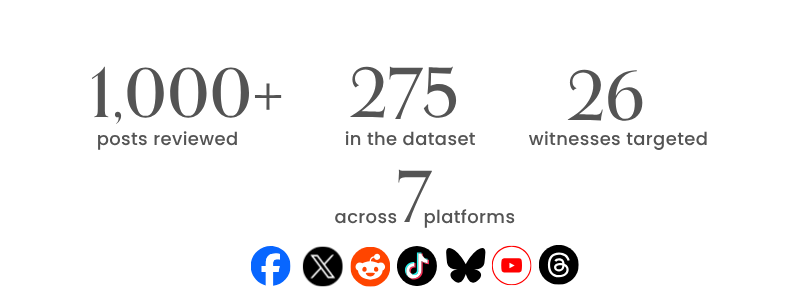
Over a four-week period, Dor reviewed a large volume of social media commentary about the hearings and witnesses who gave evidence. Dor compiled a sample of 275 posts for closer analysis, covering material dated between 3 and 29 May 2026.
The dataset spanned seven platforms, with the highest volumes concentrated on Facebook and X, and smaller amounts on YouTube, TikTok, Bluesky, Threads, and Reddit. Twenty-six witnesses who gave evidence during the hearing block were targeted across the sample of posts.
The dataset represents a small, illustrative sample of the material identified during the monitoring period. It does not capture the full extent of how widespread this material is. Its purpose is to show, plainly, the kind of abuse that Royal Commission witnesses have been subjected to.
What we found
Speaking publicly about antisemitism at the Royal Commission attracted a severe and recognisable pattern of abuse. What follows is our analysis of the themes that ran through it, illustrated with examples from the dataset. These examples are not outliers; they are representative of the dataset as a whole.
The most concerning feature of the online commentary was explicit calls for violence against witnesses and Jewish people, including invocations of mass killing and demands to “eradicate” Australian Jews in makeshift concentration camps.
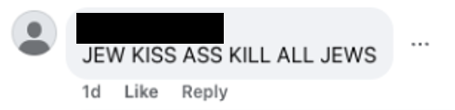
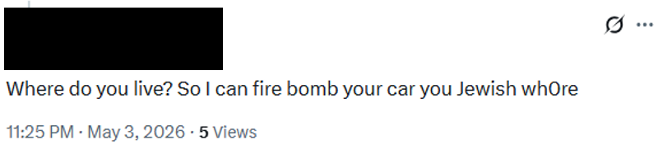
The dataset also included Holocaust glorification and distortion, with posts expressing admiration for Hitler (sometimes referred to as the “Austrian Painter”), denying or minimising the Holocaust, and mocking Holocaust survivors. Online users also directed white supremacist content towards witnesses, including ‘Great Replacement’ conspiracy theories and slogans such as “White Power”.



Witnesses were also subjected to dehumanising language, including descriptions as vermin, filth, parasites, scum, cancers, and cockroaches. Others faced sexually degrading abuse incorporating antisemitic slurs, derogatory comments about their appearance, and calls for them to be deported from Australia.
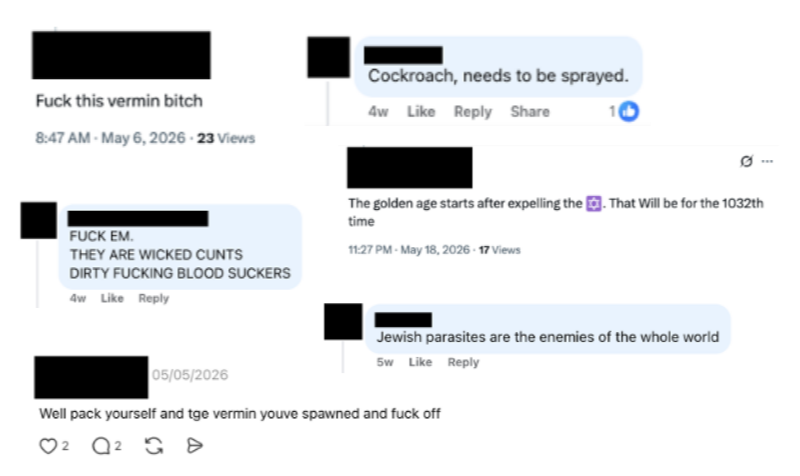
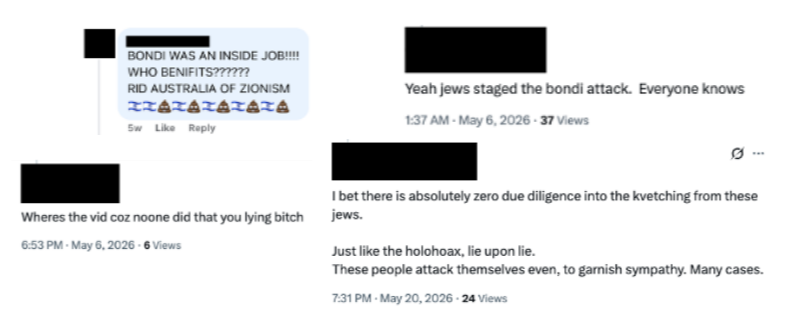
Further themes included conspiracy narratives about Jewish control of financial institutions and media, posts asserting that the Bondi terror attack was staged or carried out by Jews, and posts arguing that witnesses deserved the abuse they received. Some witnesses were described as “crisis actors” and were subject to claims that they lied or were paid to fabricate their evidence.
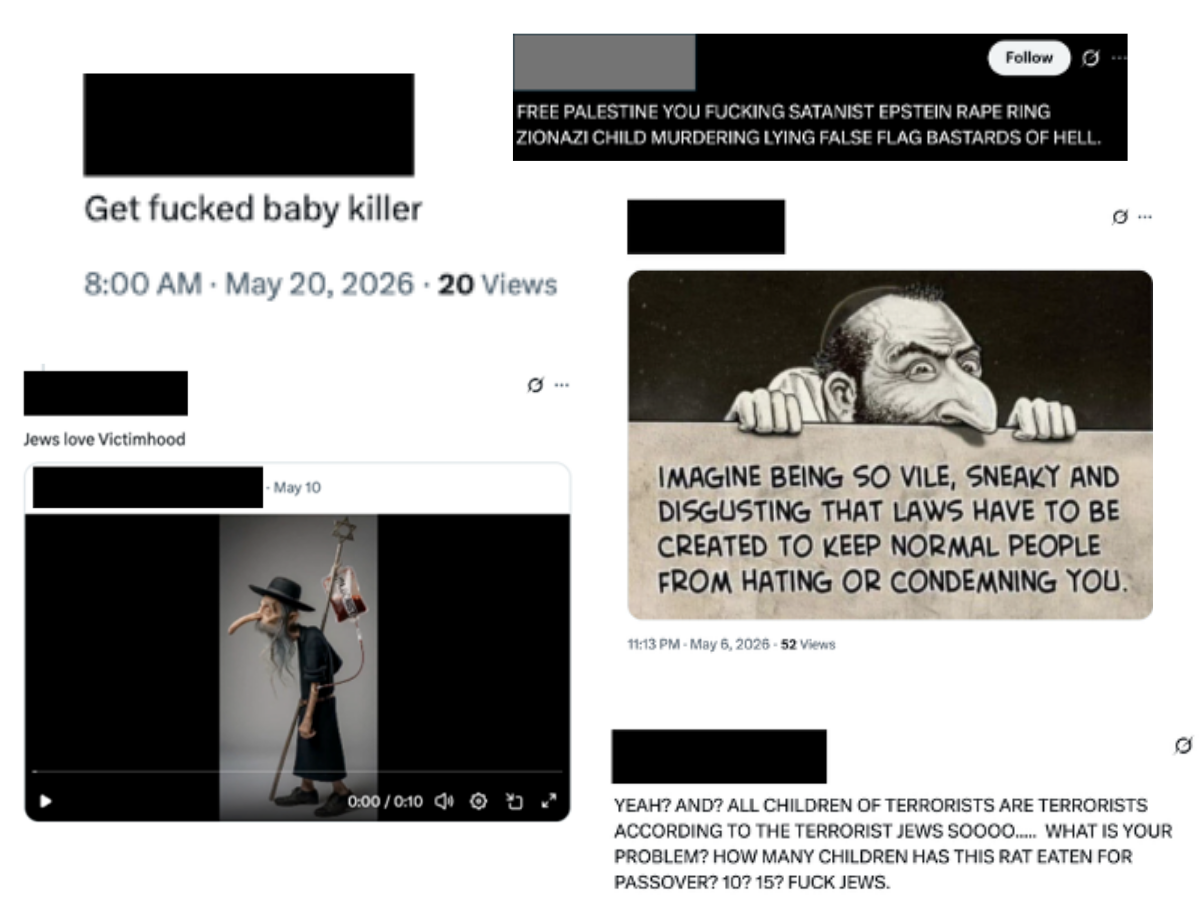
The dataset also contained a significant volume of content drawing on common antisemitic tropes, including digitally generated and manipulated images and video. These included descriptions of witnesses and Jewish people as reptilian elites, Rothschilds, and Jeffrey Epstein associates. Visual tropes such as the hooked-nose caricature and the ‘Happy Merchant’ image featured prominently. Blood libel material also appeared in both written and visual form, with several witnesses accused of killing or sexually abusing children, invoking one of the oldest and most persistent antisemitic narratives.
Comment sections beneath ordinary news and community posts were a consistent and high-volume channel of abuse. A single post reporting one witness's evidence attracted more than 3,100 comments, many of which were antisemitic or abusive. A separate post about a different witness attracted more than 800 comments.
Language drawn from those threads included calls for gas chambers, Holocaust denial, descriptions of witnesses as “vermin”, "scum", “pedos”, and "baby killers", and accusations that Jewish people "kill, rob, steal and deceive".
What we did
While undertaking this monitoring, Dor provided examples of antisemitic and abusive material to the Royal Commission. On 26 May 2026, Commissioner Bell made strong public remarks about the harassment and intimidation of witnesses, stating that they showed an “undiluted level of hatred and bigotry”, and noted that one matter had been referred to the Australian Federal Police.
Dor’s work was covered in the media and contributed to a national conversation about online hate and the personal cost faced by witnesses who chose to speak publicly about their experience of antisemitism.
Dor also engaged with law enforcement and regulatory partners, including the Australian Federal Police and the eSafety Commissioner, to share examples of the material and inform their understanding of what witnesses were being subjected to.
Following media coverage of the online hostility towards witnesses, YouTube and TikTok contacted Dor to assist with assessing material collected from their platforms and removing policy-violating posts. Dor welcomed this engagement and worked with both platforms to review a range of material collected by Dor throughout 2026.
On 30 June 2026, Dor’s CEO Tahli Blicblau gave evidence at the Royal Commission about the hostility directed towards witnesses and the response of social media platforms.
Our underlying dataset, and Dor’s research methodology, was provided to the Royal Commission into Antisemitism and Social Cohesion and will be publicly available as exhibits.
What the platforms did
In mid-June 2026, Dor reviewed the sample dataset of 275 posts to identify which ones remained active. At the time of review, the vast majority of posts remained online, including severe and overt antisemitic content that had been publicly accessible for weeks without being removed. Dor then reported all active posts to the relevant platforms via user reporting. Across platforms, very few posts were subsequently removed.
Of the 151 Facebook posts in the dataset, 150 remained active and were reported. Only five posts were subsequently removed.
Among the posts that Facebook decided not to remove were overtly antisemitic stereotypes and tropes, calls to “kill all Jews” and “eradicate” Jews in makeshift concentration camps, references to Nazi extermination methods including to “bring back the gas chambers”, a post encouraging a witness to “try sniffing zyklon b gas”, posts describing Jews as parasites and cockroaches, and posts promoting false flag conspiracy theories about the Bondi terror attack.
Dor subsequently selected a sample of 12 particularly severe posts that were initially not removed by Facebook and reported them through a second account. One post was removed, but the remaining 11 were again assessed to not violate community standards.
In one instance, Dor requested a review of a decision not to remove a post that ridiculed a witness by stating “HOLOHOAX 6 MILLIONS”, which is a phrase that seeks to portray the Holocaust as a hoax and mock the six million Jewish people who were killed. Facebook provided notification that upon review, the post had been removed, although Dor has confirmed that the post had not in fact been removed and remained online at the time of writing.
X
Of 99 posts on X, 80 were active and were reported. Nineteen posts had already been subject to enforcement by X – 13 were given limited visibility by X, five were removed entirely (sometimes because the responsible account was suspended), and one was no longer visible because the user responsible changed their privacy settings. Some of these 19 posts were actioned after being reported separately by a third-party partner organisation with ‘trusted flagger’ status.
Of the 80 posts reported via user reporting, X assessed that a policy violation took place for only two posts. As with the Facebook posts, the X posts that remained active after reporting included comments that “Hitler should’ve completely finished his work”, images of Hitler and Nazi crimes, characterisations of Jews as parasites and subhuman, and conspiracy theories that Jews staged the Bondi terror attack.
YouTube, TikTok, Bluesky, and Threads
None of the eight YouTube posts reported directly to YouTube were removed. These posts included antisemitic tropes and false flag conspiracy theories.
Of the four TikTok posts, three were removed and one remained active.
Of the nine Threads posts, three were removed and six remained active.
The posts on Bluesky and Reddit were not removed.
Why this matters
Witnesses who came forward to speak about their experiences of antisemitism were targeted for doing so. The abuse documented here was severe and sustained, and it sends a signal that speaking publicly about antisemitism carries a risk of being targeted in return. That signal was delivered across multiple platforms and multiple weeks, often without platform intervention.
The severity of the material, including explicit calls for violence, Holocaust glorification, and blood libel accusations, is not the only concern. The volume matters too, and so does the fact that so much of it accumulated in the open, in comment threads on ordinary news posts, visible to anyone reading coverage of the Royal Commission. It also accumulated on the social media pages of Jewish organisations, leaders, and witnesses themselves.
This is not content confined to the fringes. It is content that reached mainstream spaces and largely remained there.
A society that allows people to be abused at this scale for telling the truth about their experience makes that truth harder to tell. The platforms that host this content, and benefit from the engagement it generates, have a responsibility to act on it without waiting to be prompted.
What next
Dor is working with the Executive Council of Australian Jewry (ECAJ) to support efforts to strengthen the identification and reporting of antisemitic content across social media platforms.
As part of this work, we are collating examples of online antisemitism to help better understand how antisemitic content appears and evolves online.
If you have encountered antisemitic content on Facebook or Instagram, we encourage you to share it. This may include posts, comments, videos, memes, accounts, hashtags or emerging trends that target Jewish people because of their identity.
Please include screenshots, links and any relevant context. Examples can be submitted to the ECAJ up to 5 July 2026 via onlinehate@ecaj.org.au.
Support
We acknowledge that some of this content may be distressing. Confidential support is available through Jewish House on 1300 544 357, Jewish Care on 1300 133 660, or Lifeline on 13 11 14.