
The Australian Jewish News, 27 May 2026
Royal Commission witnesses face online abuse
Dor Foundation CEO warns online attacks confirm 'vital' need for inquiry
By Bruce Hill
The Royal Commissioner examining antisemitism in Australia has issued a scathing warning to people who have intimidated and harassed witnesses giving evidence to the inquiry.
The Australian Federal Police is investigating at least one matter arising from the online abuse.
Dozens of witnesses have given evidence to the Royal Commission into Antisemitism and Social Cohesion this month, providing examples of abuse they have received for being Jewish.
Royal Commissioner Virginia Bell opened Tuesday’s hearing by saying she was disturbed by the number of reports of continued abuse against lived-experience witnesses who have spoken at the inquiry.
“We have received reports from a number of witnesses concerning a dramatic increase in online hate messages,” Commissioner Bell said.
She said the messages showed the depth of hostility directed towards Jewish Australians.
“Quite what this undiluted level of hatred and bigotry directed towards members of the Jewish community is thought to benefit by those who post these remarks is lost on me,” she said.
Commissioner Bell said the Commission was “keeping a close eye on these instances and recording these offensive social media posts”, and confirmed that “in one instance the matter has been referred to the Australian Federal Police for investigation.”
Evidence of the online abuse was compiled by The Dor Foundation, which catalogued more than 1,100 antisemitic or abusive posts directed at the Royal Commission and witnesses between 4 and 25 May.
From this dataset, it identified 156 posts containing the most severe abuse for detailed analysis, which it provided to the Commission.
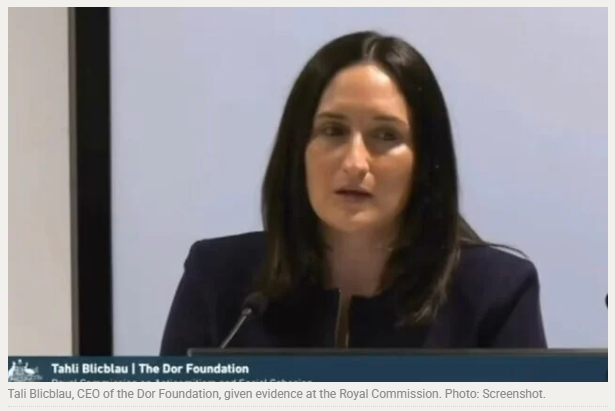
Dor Foundation CEO Tahli Blicblau said the targeting of witnesses cut to the heart of Australian democratic life.
“Abusing witnesses to a Royal Commission strikes at something fundamental: the principle that Australians can participate in democratic processes without fear. It confirms the importance of the Commission’s work,” Ms Blicblau said.
“The abuse included death threats, Holocaust glorification, dehumanising racist slurs and intimidation campaigns targeting ordinary Australians, including children.”
Ms Blicblau noted that many of those targeted had no public profile.
“They are individuals sharing deeply personal experiences, but the message sent to them online was unmistakable: speak up, and you will be punished for it.”
Posts were captured across X, Facebook, LinkedIn, Instagram, TikTok and YouTube.
Witnesses targeted included communal leaders, experts and laypeople, as well as those who gave evidence under pseudonyms, including a Jewish child.
The Foundation’s analysis identified seven thematic categories of abuse. Posts called for witnesses to be “executed”, invoked concentration camps as a proposed solution and expressed genocidal sentiment.
Witnesses were described using animal comparisons including “cockroach”, “parasite”, “rat” and “vermin”, with a victim of the Bondi terror attack referred to as a “Chabad subhuman”.
Holocaust mockery featured prominently, with posts referring to the Holocaust as the “holohoax” and one stating that “Hitler should’ve completely finished his work”.
Posts targeting an anonymous Jewish child witness included calls for “Heil Hitler” and “Deport Kikes”.
Classical antisemitic tropes appeared in multiple posts, including the Rothschild conspiracy theory and blood libel analogies.
A significant cluster called for Jewish Australians to leave the country, with phrases including “fuck off to Israel” and calls for the government to fund “one-way fares”.
False flag conspiracy theories were also prevalent, with some posts intended to taunt witnesses whose family members were murdered or injured in the Bondi attack.
Ms Blicblau said the conduct would not be tolerated in any other setting.
“We wouldn’t tolerate this sort of language or conduct in the physical world, and we shouldn’t tolerate it online where it can reach millions of people,” she said.
“Our online spaces have become the front line in the fight against antisemitism. Extreme hate no longer stays on the fringes. It spreads fast, it amplifies fast, and it becomes deeply personal very quickly.”
Ms Blicblau called for a coordinated response across government and industry.
“No single organisation can solve this alone. It will take genuine partnership between government, digital platforms, regulators, the eSafety Commissioner, researchers and civil society to understand the problem and take preventative action before harm escalates,” she said.
Ms Blicblau said the abuse was itself evidence of the phenomenon the Commission was examining.
“The Royal Commission was established to understand the lived experience of antisemitism. The online abuse that followed the first block of witness testimony is not incidental to the Commission’s work: it is the Commission’s work. It makes the need for this inquiry abundantly clear, and its ongoing work absolutely vital.”