
ABC News, 6 July 2026
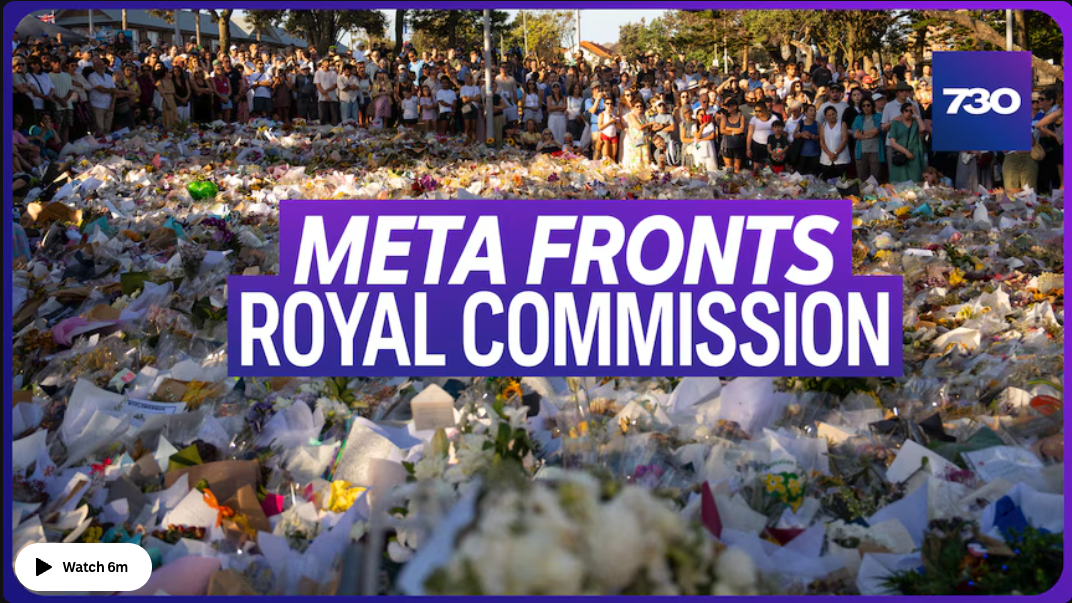
ABC 7.30 - Social media giants front royal commission into antisemitism
Transcript:
JASON OM, REPORTER: Moments after the Bondi terror attack, Arsen Ostrovsky was one of the survivors whose image was beamed around the world.
ARSEN OSTROVSKY: This was a blood bath, it was an absolute massacre
ARSEN OSTROVSKY: It was literally millimetres between life and death. The bullet scraped my head to the bone.
JASON OM: Arsen Ostrovsky has a large profile on X. As he lay on the grass in Archer Park, he sent this selfie to a friend who then posted it on the platform, with his permission.
The backlash was almost instant. Users accusing him of faking his injuries in these images of tomato sauce bottles and this elaborate deep fake appearing to show him smiling getting make-up done.
ARSEN OSTROVSKY: It obviously went quite viral but to then see that image within hours become the target of sickening vitriol was incredibly jarring. The experience was dehumanising. It was erasing what had happened to me.
JASON OM: Did you ever find the source?
ARSEN OSTROVSKY: No but what I do know is that it was allowed to proliferate unabated on some of the media platforms
JASON OM: Arsen Ostrovsky works for the Australia-Israel Jewish Affairs Council in Sydney and is a fierce defending of Israel.
He was one of the witnesses in this round of hearings at the antisemitism royal commission.
COUNSEL-ASSISTING: You are an active participant in robust debates about issues affecting Jewish people online.
ARSEN OSTROVSKY: I am indeed.
COUNSEL-ASSISTING: You are no stranger to criticisms of some of your posts?
ARSEN OSTROVSKY: That is correct.
JASON OM: He told the commission that he reported misinformation about him to the social media companies. He said Meta was the most responsive, the others did little or nothing.
ARSEN OSTROVSKY: I reported it recently again on YouTube where I saw videos and podcasts still circulating to this day, calling Bondi a intelligence operation, a false flag operation, that I was a crisis actor. So these videos still exist on YouTube.
JASON OM: This week representatives from the social media giants are fronting the commission including Meta’s Global Core Policy Director Benjamin Good who today defended the company’s removal policies via video link in the US.
BENJAMIN GOOD, META: The content that violates should be removed. We report on our enforcement metric publicly and find that it is removed overwhelmingly.
MARK ZUCKERBERG: I want to talk about something important today.
JASON OM: In January last year Meta cut its independent fact checkers claiming that third party moderators were politically biased.
MARK ZUCKERBERG: The reality is that this is a trade-off. It means we’re going to catch less bad stuff, but we’ll also reduce the number of innocent people’s posts and accounts that we accidentally take down.
JASON OM: That shift, the commission heard, meant content related to terrorism or child exploitation was removed proactively by AI, a method Mr Good called the gold standard but that hateful conduct such as antisemitism was removed reactively based on user reports.
VIRGINIA BELL, ROYAL COMMISSIONER: But the reactive approach necessarily can never achieve the gold standard can it?
BENJAMIN GOOD: It’s true that there may be content that we don’t remove because it is not reported but I do want to emphasize that we are very carefully monitoring the extent to which that is the case.
JASON OM: The commission heard there was a more than 70 per cent drop in the amount of hateful content Meta took action on which Mr Good could not explain.
VIRGINIA BELL: Can you suggest a plausible explanation for a drop of say 79 per cent in the metric of hateful conduct content other than the announced change in the policy that occurred in late January 2025?
BENJAMIN GOOD: I truly don’t know and I don’t want to speculate. I don’t know if this relates solely or entirely to a switch to reactive enforcement.
JASON OM: X is among the companies that is not cooperating with the royal commission.
Last week Australia’s eSafety Commissioner Julie Inman Grant revealed that X had fought to keep gruesome content from the Bondi massacre on its platform.
JULIE INMAN GRANT, ESAFETY COMMISSIONER: They said it’s not any worse than you would see in a gore movie. I said I can’t think of anything more horrific for the family members and the Australian Jewish community.
JASON OM: But while the eSafety Commissioner said she was doing all she could to fight the companies, she also said there were limitations on her own powers to have content removed because of slow legal and administrative processes and under resourcing.
JULIE INMAN GRANT: I'm really sorry about the shortcomings of the scheme and when we haven’t been able to help.
We’ve got the most powerful technology in the world owned by the richest wealthiest technologists in the world, but we’ve never had looser guardrails and that to me is a recipe for disaster.
JASON OM: Every day at the commission there’s been a huge police presence but while that protects the physical safety of witnesses, it hasn’t prevented them from being targeted online.
The commission has heard that some witnesses have been threatened with firebombing, been called cockroaches or vermin or been told that the Bondi terror attack was fake.
Again, the content was reported to social media companies but only a very small percentage was removed if at all according to evidence documented by the Dor Foundation.
TAHLI BLICBLAU, THE DOR FOUNDATION: It’s clear that the platform response is entirely out of step with normal community expectations of how people should treat on another and I think it is fair to say that either the legislation or policies are not effective or are not being effectively enforced.